Temple-Themed Slots: Compare Cascades, Splitz and Free Spins
Temple-themed slots share ruins, treasures and jungle settings, but their win structures differ. Temple Tumble clears stone blocks on a ways board, Solar Temple uses fixed lines and Flaming Frames, and Temple Stacks splits symbol positions. Compare the feature you want to follow before choosing by artwork.


About Temple Theme
Ruined temples provide a setting, rather than one shared mathematical model. The illustrated archive includes changing ways, fixed paylines, split positions and feature choices. The profiles below identify what moves, what creates a win and how a bonus starts. A temple in the background does not establish the same reel shape, return configuration or free-spin rule. Start with a structure, then use the complete game title to find the right illustrated entry.
Top Temple Theme Slots
These four profiles separate board clearance, changing ways, fixed paylines and large symbol blocks. Read the rule that creates a win before comparing the temple artwork.
Temple Tumble: clear the stones
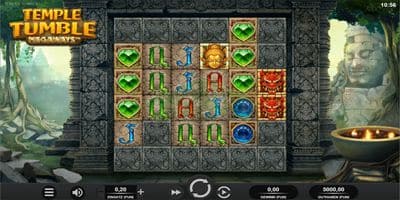
Temple Tumble uses a six-by-six board with stone blocks covering some positions. Relax Gaming advertises up to 46,656 ways, not 46,656 fixed paylines. Wins remove symbols and help clear the stones, opening the board. Clearing every stone starts a choice between three free-spin modes. The progression is therefore physical clearance of blocked positions. It differs from landing temple scatters and from retaining a wild on an otherwise fixed line display. See Relax’s original Temple Tumble description.
Temple of Treasure: changing ways
Temple of Treasure Megaways is Blueprint’s changing-reel temple game. Up to seven symbols on each of six reels can create a maximum 117,649 ways. The number is a configuration count, not a payout and not a guarantee of matching symbols. Four scatters open a bonus selection. The operator’s explanation separates fifteen spins with a 324-way minimum, ten with 2,304, five with 10,000, and a Mystery Choice that combines a revealed spin count and minimum ways. These are different choices from clearing Temple Tumble’s stones.
Solar Temple: fixed lines and frames
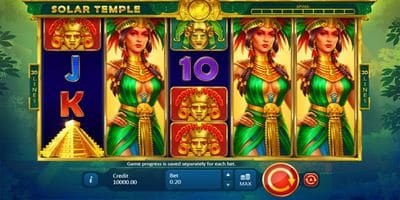
Solar Temple uses five reels, four rows and twenty fixed paylines. Playson identifies Flaming Frames and a progressive multiplier as its central features. Here a framed position is part of the feature display, while a line still determines whether a regular combination pays. That distinguishes the game from Temple Tumble’s blocked board and Blueprint’s variable reel heights. The twenty-line format is useful if you want visible line patterns rather than a changing ways counter. See Playson’s Solar Temple page.
Temple Quest Spinfinity: large blocks
Temple Quest Spinfinity keeps forty lines and changes symbols through large blocks. Big Time Gaming describes Mystery Mega Symbols and bonus Mega Scatters; retriggering can expand the free-spin award. A large symbol occupying several positions is a different device from changing the number of symbols on every reel. Read its complete title: Spinfinity and Megaways do not name the same structure. The supplier’s product page is the reference for this edition. Its own installed help takes precedence for the current RTP configuration.
Temple Stacks: positions split rather than reels grow
Temple Stacks uses Yggdrasil’s Splitz system: a symbol position can divide into three to nine copies of the same symbol. This changes the matching combinations through the reels without requiring every reel to be taller. Two scatters start a wild respin; a third during that respin opens free spins. The choice then moves through Bronze, Silver, Gold and Diamond levels. These named steps distinguish it from both a stone-clearance trigger and a four-scatter Megaways choice. See Yggdrasil’s Temple Stacks description.
The visual question is “how many copies occupy this position?” rather than “how many rows are currently on this reel?” Count the split copies only where the exact game permits them to form a combination. A split high-value symbol is not automatically a multiplied cash prize; the paytable, participating positions and current feature mode determine the award.
Lines and ways: a small counting example
Suppose a three-reel section has two matching masks on the first reel, three on the second and one on the third. In a conventional ways system those positions create 2 × 3 × 1 = 6 combinations for that matching run. They are not six predetermined line drawings. A fixed-line game instead pays only the matching runs that follow its active line patterns. The example explains the counting distinction; it is not a paytable for any particular temple title.
The advertised maximum ways counts all eligible positions, including symbols that do not match. A six-reel display with seven positions on every reel has 7 × 7 × 7 × 7 × 7 × 7 = 117,649 possible ways, but most cannot be wins for one symbol on the same board. Temple Tumble’s six-by-six maximum is 6 to the sixth power, or 46,656. Neither number can be compared directly with a prize expressed as times the stake.
Use the feature you want to follow as a starting point. For blocked positions being cleared, choose the Temple Tumble profile. For variable reel heights and a trade-off between spin count and minimum ways, read Temple of Treasure. For fixed lines with visible frames, start with Solar Temple. For copied positions, read Temple Stacks; for a single large symbol block, compare Temple Quest Spinfinity. These routes keep a theme hub useful beyond its logo archive.
All Temple theme slots