
Tome of Madness: Portal Features and Similar Slots
Tome of Madness is a Play’n GO cluster slot built around a charging Portal. Its main comparison is the sequel, Tome of Insanity, followed by games with cascading boards and feature meters. Gem artwork alone is a much weaker match.
The Portal controls which effects become available during a winning round. The eye positions set a different target during Other World. Understanding those two displays gives a better basis for choosing an alternative than comparing return percentages or gemstone artwork alone.
Tome of Madness casinos
Play Tome of Madness slot game at these top casinos.





 Reviewed by Paul Stone
Published: January 2019
Tome of Madness: compare the Portal, not the setting
The Portal is the main reason to compare Tome of Madness with another grid slot. Winning clusters feed it, and reaching its thresholds changes symbols or advances the round towards Other World. Moon Princess uses character powers and a Trinity meter instead; Sweet Alchemy moves from its main grid into a larger free round. They share changing grids, but do not share the same bonus sequence.
Rich Wilde and the Tome of Madness is the full name of this game. The other Rich Wilde listing refers to the same release, not a five-payline sequel. Play’n GO’s Tome of Madness walkthrough is the reference for the Portal and Other World progression.
From a cluster win to Other World
Four matching symbols touching horizontally or vertically form a win on the 5×5 grid. Diagonal contact alone does not qualify. Winning symbols disappear, allowing new ones to drop into their places. The Portal counts the symbols involved, so its progress is separate from the cash amount displayed for a win.
The Portal’s four stages
- Seven collected symbols: two Special Wilds are added.
- Fourteen: two Special Wilds can activate Abyss when used in a win, clearing a row or column.
- Twenty-seven: the wilds can activate Void, removing every instance of a selected regular symbol.
- Forty-two: Other World opens for a free round.
These stages explain why a board can start winning again after its ordinary cascades stop. A Portal effect changes the symbols, which can produce another cluster and another drop. Read the current stage alongside the board rather than expecting each paid spin to end at the first pause. The supplier’s Tome of Madness overview illustrates this sequence.
Eye marks and Cthulhu
Other World starts with three Portal effects. Collecting symbols beyond its trigger can increase that total to seven. Effects play after the available cascades have finished. During the round, wins over the 11 or 12 eye marks open them; opening every eye brings Cthulhu onto the grid. This Mega Wild moves down with the cascades before leaving.
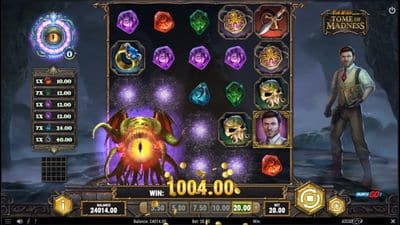
The eye display and the Portal are therefore doing different jobs. The Portal governs the effects available to the round, while the marked positions show where wins are needed to release Cthulhu. Reaching Other World does not itself guarantee that every eye will open. That distinction is useful when comparing a screenshot of the ordinary grid with one from the feature.
Following one round without mixing the counters
Consider an illustrative moment with six symbols already collected. A qualifying cluster of four would take the running total to ten and cross the first Portal threshold. That is four collected symbols from one winning group, not four separate spins. The round can keep developing through cascades and effects before the next paid spin begins. The number collected, the cash award and the number of Portal effects are separate measurements.
The eye map adds a positional question. A large win elsewhere on the board is not automatically the same as clearing the positions marked by eyes. When comparing the display with the screenshot, identify the grid first, then the map and the Portal. A coloured symbol, an eye position and a book wild can all be visible at once while fulfilling different roles. This is why a generic “random wilds” label leaves out much of the game’s identity.
There is also a practical difference between progress within a round and an expectation about the next paid round. Getting close to a threshold does not make a future stake safe. Use the current game display to follow what is happening, rather than treating an unfinished meter as money owed by the game. The mechanics explain the sequence; they do not predict the result.
Slots with a similar feature sequence
Tome of Insanity: how the sequel changes the rules
Tome of Insanity retains a 5×5 board and the connection between wins, a charged Portal and a large creature wild. Its Portal of Chaos uses thresholds of eight, 16, 30 and 48 symbols. The stages add wilds, remove symbols, upgrade lower-value symbols and finally award a free spin. Those thresholds should not be substituted for the original’s seven, 14, 27 and 42.
The sequel also uses two colours of eyes. Opening 12 red eyes summons Yog-Sothoth as a 2×2 Mega Wild in a three-stage sequence. Green eyes affect that wild’s multiplier: three, four or five opened green eyes give x2, x3 or x4. Compare this version if you want the eye positions to have an additional multiplier role. The original’s Cthulhu sequence is easier to distinguish once you separate that change from the shared horror setting. See Play’n GO’s Tome of Insanity explanation.
Reactoonz: a larger grid with a different target
Reactoonz is a useful alternative for the cascade-and-meter structure. Its 7×7 board needs five matching neighbours for a cluster, making the playing area and minimum group different from Tome of Madness. Instead of opening eye marks, its charged Quantum features lead towards Gargantoon’s changing wild sizes.
That gives you a practical choice between the games: Tome of Madness ties its large-wild event to marked positions during Other World, whereas Reactoonz builds through queued board modifiers. The Reactoonz feature guide explains that sequence with gameplay images. The gem-themed games below broaden the visual selection, but a shared symbol style is a looser match than either of these feature systems.
The original Tome of Madness rules cover matching, Portal effects and the Other World sequence.
Games like Tome of Madness
Gemtastic and Gems Gone Wild provide two different comparisons for symbols changing into wilds. Jade Magician contrasts a conventional free-spin trigger with the Portal sequence. Prism Blast belongs to the broader gemstone theme, rather than being presented as a mechanically equivalent substitute.

Prism Blast is a visual alternative for readers drawn to brightly coloured gemstones. That is a narrower connection than the charged Portal and eye-map systems explained above. A gem symbol or a similar background does not establish a cluster threshold, a queued board effect or the Cthulhu sequence. If those are the parts of Tome of Madness you want to compare, begin with Tome of Insanity or Reactoonz. Use Prism Blast as a separate theme route and read its own help before applying any feature or payout claim from another game.
Red Tiger’s Gemtastic has a six-by-five display with thirty lines and a chain-reaction structure. Its Magic Glow can mark a gem type; when those gems contribute to a win, they become wilds for the respin. Large Mega Gems can also disperse into smaller wilds. That is a concrete comparison with Tome of Madness’s board-changing effects, but the trigger differs: follow the marked gem and winning line rather than a Portal threshold. The Lava Multiplier is another game-specific feature, not evidence that both titles share a multiplier schedule. The supplier currently lists 96.07% for its published configuration; the actual loaded setting remains the relevant return figure.

Gems Gone Wild focuses on a more immediate wild-and-respin relationship. Red Tiger describes gems turning wild, with each new wild triggering a free respin. The five-by-three display and twenty lines also contrast with Tome of Madness’s square cluster board. There is no reason to translate a repeatable respin into a promise that dry spells will be short or a balance will last longer. The useful comparison is what creates the next result: a new wild here, versus the Portal’s collected-symbol progression in Tome of Madness. The shared cosmic gemstone setting is secondary to that mechanical difference.

Prism Blast
A theme comparison for the gemstone presentation. It is not a Rich Wilde sequel, and the artwork does not establish an equivalent Portal or eye-map feature.
Gemtastic
Watch for a marked gem participating in a line win. Its conversion into wilds for the respin differs from collecting symbols towards a threshold. Large symbols also change how the resulting wild positions appear.
Gems Gone Wild
The key event is a new wild and the respin it triggers. This is a more direct wild feature than a four-stage meter followed by a separate eye target.
Jade Magician
Play’n GO’s Jade Magician uses five reels, three rows and fifteen lines. Two Magician symbols offer a Second Chance pick between elemental choices; three scattered Magicians award five free spins. Its wild has a doubling function and the free-spin sequence can be extended. This makes it a useful same-studio contrast: symbols trigger a pick or free spins directly, rather than feeding the Tome of Madness Portal. An elemental selection is not the same as choosing a known outcome, and a doubling wild is not a general multiplier on every future spin.
Slots similar to Tome of Madness
The cave setting gives the eye marks, book and coloured stones different places on one board. The book acts as a wild, while matching symbols contribute to clusters and the Portal count. Recognising their separate roles makes the display easier to read than a general description of a gemstone theme.
The screenshot shows the large creature over the original grid. That is the Cthulhu feature state, rather than a second game or a larger permanent reel layout. The surrounding controls belong to the pictured version; they are not evidence of the stake limits at every casino.
Gems of Adoria, More Gold Digging, Da Vinci Diamonds Dual Play and Progressive Diamond Jackpot are further gemstone settings. For the Portal and eye-map sequence, use the detailed Tome of Insanity comparison instead of assuming these themed titles reproduce it.
Tome of Madness combines gemstone symbols with Rich Wilde’s occult adventure setting. The books, Portal and eye map are not merely decorative: they identify separate rules within its feature sequence.
Gems slots you might enjoy

Dream Zone, Gem Drop, Glitz and Flux provide further gemstone-themed routes. They broaden the artwork selection; they are not a second list of verified Portal equivalents. Choose the sequel and meter-based comparisons above when the feature sequence is the priority.



Play’n GO, the software provider behind Tome of Madness

Play’n GO supplies the Rich Wilde games, including Tome of Madness and Tome of Insanity. Their shared character and five-by-five boards provide a clear family connection, but the different charge thresholds and eye systems need separate explanations. A studio label alone is not a rulebook.
The Play’n GO name helps identify the correct publisher of the Rich Wilde games. The full title Rich Wilde and the Tome of Madness identifies this game; a separate catalogue page using the longer name is not evidence of another sequel.
Compare the board first when moving between Play’n GO games. Tome of Madness counts adjacent groups on its square grid. A title with conventional reels and drawn paylines resolves ordinary wins differently, even when both games contain wild books or ancient treasures.
Ace of Spades, Aztec Warrior Princess, Big Win Cat and Cat Wilde and the Doom of Dead are other catalogue settings. The shared publisher supplies a browsing connection; the individual feature rules provide the gameplay comparison.
Hugo 2, House Of Doom, Jewel Box and Cash Vandal are additional Play’n GO catalogue routes with different settings. They show the breadth of the supplier’s range rather than forming a series of Tome of Madness sequels.


Tome of Madness at a glance
The grid and Portal sequence identify the original game. Return, stake limits and maximums must be matched to the specific configuration; historical catalogue positions are not live popularity rankings.
| Tome of Madness Slot Info | |
|---|---|
| Name: | Tome of Madness |
| Provider: | PlayNGo |
| Developer Rank: | 12 out of 159 PlayNGo games |
| RTP: | Variable RTP configuration; see game help |
| RTP Category: | Depends on the casino configuration |
| RTP Rank: | 3282 out of all games |
| Feature Description: | Cluster Pays, Free Spins, Multiplier, Random Wild, Rtp Range, Symbol Swap, Wild |
| Feature Categories: | Free Spins, Cluster Pays, Random Feature, Random Wilds, Increasing Multipliers, Improving Symbols |
| Reels: | 5 |
| Rows: | 5 |
| Paylines: | Cluster Pays |
| Volatility: | Very High Volatility |
| Volatility Rank: | 88 out of all games |
| Min Bet: | Read the minimum total stake in the loaded game. |
| Max Bet: | Read the maximum total stake in the loaded game. |
| Max Win: | 2,000x total stake |
| Slotslike Rank: | 256 out of all slots View Top 100 |
Tome of Madness’s grid and Cthulhu feature artwork. Use the separate Portal and eye-map explanation to distinguish charge progress from marked positions; small stake controls are best read in the loaded game.
Slot games with the same bonus features as Tome of Madness
The following groups are broad feature routes. Free spins, clusters and wilds occur in many formats; none of those labels alone establishes the full Portal-to-Other-World sequence.
Other slots with Free Spins
Fire N Hot, Voodoo Gold, Firefly Frenzy and Paint provide other free-spin catalogue routes. Their triggers and in-feature rules should be compared individually rather than borrowed from Tome of Madness.




Slot games with Cluster Pays
Dragonfall, Royal Gems, Brood of Gods and Scara Bucks are further cluster-category routes. Compare group size, adjacency and what persists after a win before treating any of them as a close mechanical match.


Slots with Random Feature
The illustrated random-feature routes are Red Hot and Volcano Eruption Extreme. A randomly activated modifier is a broad connection; the pictured games should not be mistaken for the Portal stages or the eye-map target.


Slots with Random Wilds
Divine Dreams and Queen Of Thrones are additional wild-feature routes. The relevant question is how a wild appears and how long it remains, rather than simply whether the game contains a wild symbol.

Tome of Madness slot sites FAQs
Which slots play like Tome of Madness?
What is the RTP of Tome of Madness?
Who makes Tome of Madness?
What special features does Tome of Madness have?
Is Tome of Madness high or low volatility?
What is the max win on Tome of Madness?
How many reels and paylines does Tome of Madness have?
What is the minimum and maximum bet on Tome of Madness?
Can I play Tome of Madness for free?
Tome of Madness Pros and Cons
Tome of Madness’s defining strengths are the connected Portal stages and separate eye target. The trade-off is a more involved sequence than a straightforward reel-wild respin.
Pros
- Other World combines queued Portal effects with an eye-mark target
- Tome of Insanity and Reactoonz offer distinct, explained comparisons
- The Portal stages give a clear progression through a winning round
- Special Wilds and the Cthulhu Mega Wild affect the board in different ways
Cons
- Several displays need attention during the feature, rather than one simple spin counter
- The available RTP varies between casino configurations
- Very high volatility can produce uneven results; feature progress is not a promise of a return
- No progressive jackpot on offer